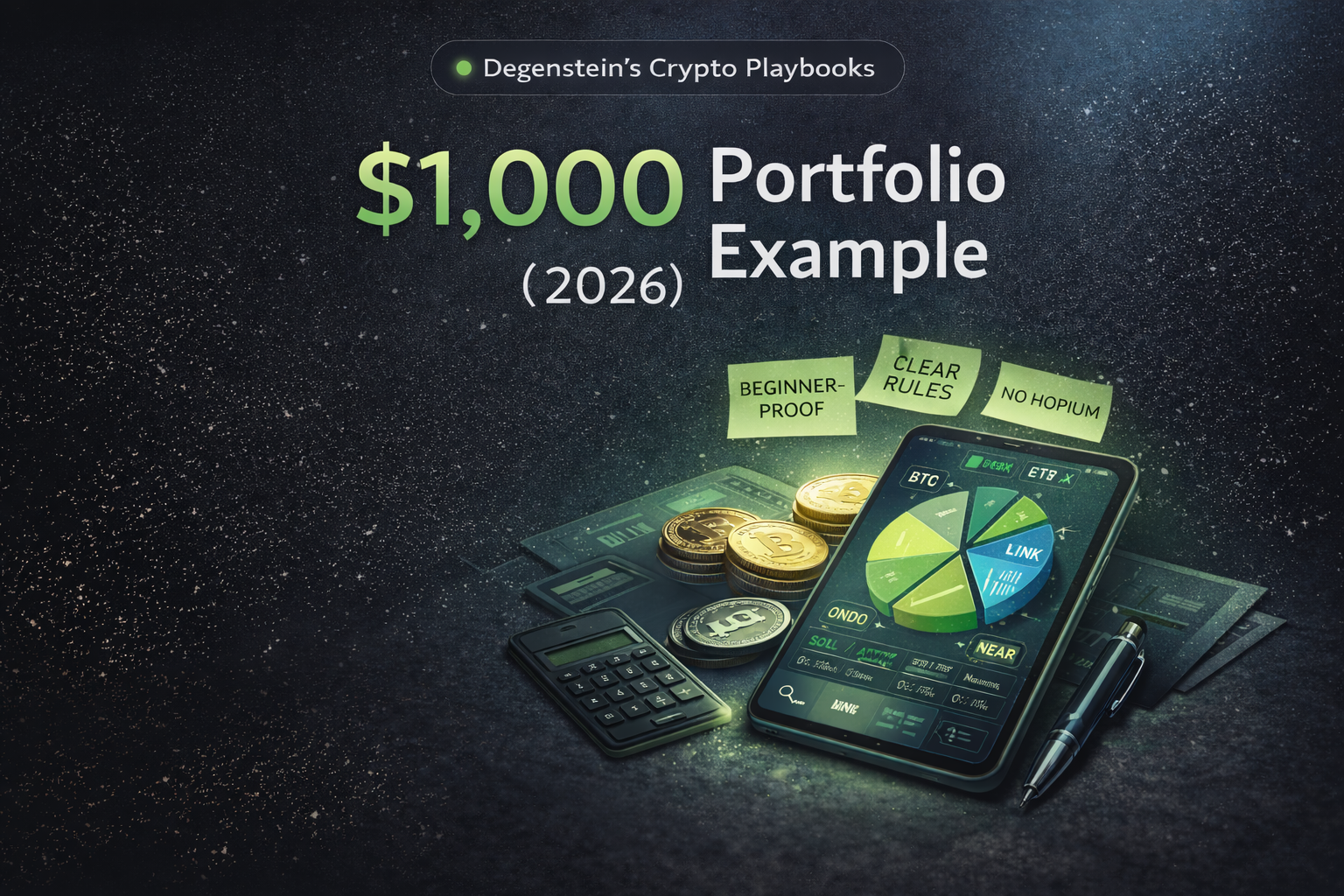
$1,000 Crypto Portfolio — July 2026 Example
A simple July 2026 example designed to reduce FOMO behavior and spread risk across monetary assets, settlement rails, infrastructure, tokenization and high-throughput execution. Clear rules > vibes.
Goal of this playbook
Build a six-asset crypto example with 50% in BTC + ETH and the other half spread across four distinct 2026 theses. This is not designed to maximize upside. It is designed to make a $1,000 crypto allocation easier to understand, monitor, and rebalance.
Suggested allocation (example)
This July 2026 example uses $1,000. The percentages are illustrative research weights, not personalized recommendations.
Why I changed the allocation for July 2026
The earlier version grouped BTC and ETH into one 40% bucket and asked the reader to pick SOL, AVAX, or NEAR for the final 10%. That made a beginner playbook less clear than it should be. This version assigns an exact dollar amount to every asset.
- BTC + ETH = 50%: half of the example stays in the two largest crypto networks by market capitalization.
- XRP = 15%: settlement-rail exposure with a 2026 institutional-product demand thesis.
- LINK = 15%: CCIP, CRE, data, and tokenization infrastructure exposure.
- ONDO = 10%: tokenized-market exposure, with direct ONDO value capture still treated as an open question.
- SOL = 10%: higher-beta execution exposure tied to payments, stablecoins, and tokenized assets.
Four-tranche entry example
One simple implementation is to divide the entire portfolio into four equal deployment rounds. Each round invests $250 using the same target weights.
Rules (this is what makes it work)
- No automatic chasing: a vertical candle is a reason to re-check entry risk, not proof you must buy immediately.
- Stage entries: for this example, split each allocation into four 25% tranches instead of deploying the full $1,000 at once.
- Review quarterly: rebalance only when weights or theses materially change. Avoid constant tinkering.
- Define thesis failure: ecosystem growth without token value capture, weakening liquidity, adverse supply changes, or a broken catalyst should trigger review.
When I add (simple triggers)
- After a planned tranche date or meaningful pullback when the asset thesis remains intact.
- After consolidation or improving market structure rather than during vertical price expansion.
- When measurable adoption, flows, fees, volume, or infrastructure usage strengthen the thesis.
Custody and yield are separate decisions
Buying a token, choosing where to custody it, staking through a protocol, and transferring assets to a third-party interest platform are separate risk decisions. Do not choose a token because a platform advertises a high rate.
- Self-custody: wallet-security responsibility and loss-of-key risk.
- Protocol staking: validator, smart-contract, slashing, lockup, and protocol risks can apply.
- Custodial interest platforms: add counterparty, custody, liquidity, legal, and asset-use risks.
For a separate review of advertised rates, custody terms, and platform risks, see the CoinDepo research review →
CoinDepo rates, terms, and availability can change. Some links in the separate CoinDepo report are referral links and are clearly disclosed there. Third-party interest is not protocol yield and is not used to justify this portfolio example.
Research checklist before every quarterly review
- BTC: ETF flows, liquidity, network security, and macro sensitivity.
- ETH: settlement activity, tokenization, scaling economics, and ETH value capture.
- XRP: ETF demand, payment activity, XRPL usage, and direct XRP liquidity demand.
- LINK: CCIP usage, CRE adoption, fees, staking economics, and LINK demand.
- ONDO: tokenized-asset growth, governance utility, supply, unlocks, and token value capture.
- SOL: stablecoins, RWAs, payments, fees, resilience, and SOL economic demand.
Next playbooks
- $5,000 Portfolio Playbook (core + small upside sleeve)
- Memecoin Sleeve Playbook (strict risk rules)
About · Contact · Editorial Policy · Terms · Privacy