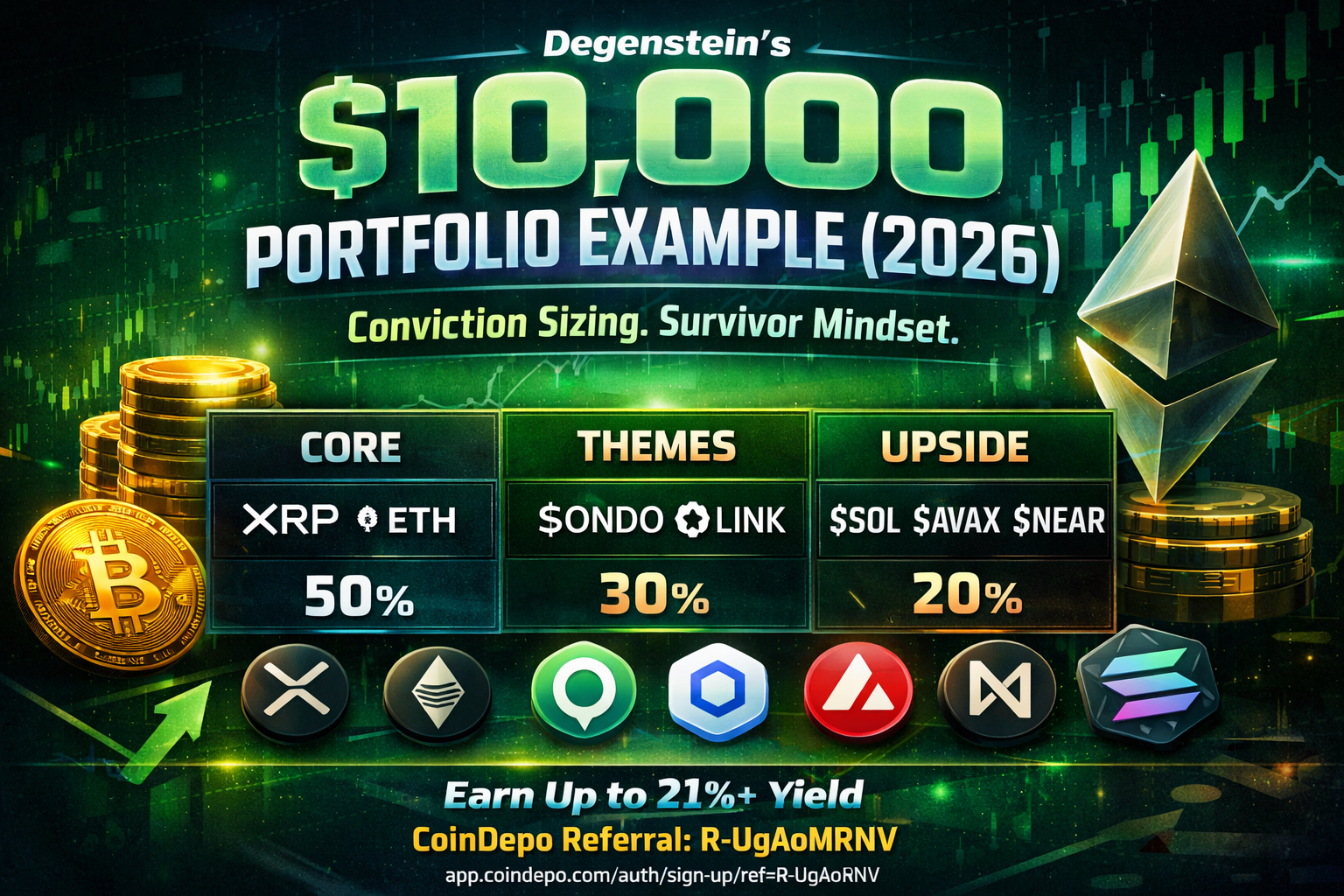
$10,000 Crypto Portfolio — July 2026 Example
With $10,000, this July 2026 example puts the majority of capital in BTC and ETH, then uses smaller positions for settlement,
high-throughput execution, interoperability, and tokenized-market exposure. Structure first. Narratives second.
Goal of this playbook
Build a crypto-only allocation that is easier to monitor through a volatile cycle. The goal is not maximum theoretical upside. The goal is to combine deep-liquidity core assets with four measurable 2026 infrastructure theses and explicit review rules.
Portfolio structure
- Core (60%): BTC and ETH — the two largest crypto networks by market capitalization.
- Infrastructure themes (30%): XRP, SOL, and LINK across settlement, execution, and interoperability.
- Tokenized markets (10%): ONDO as a higher-risk RWA ecosystem and value-capture thesis.
Suggested allocation (example)
Why these assets
Asset selection in this portfolio is intentional. Each position serves a specific role within the broader structure — balancing network dominance, institutional relevance, and asymmetric upside without relying on speculative narratives alone.
-
$BTC — Monetary core and liquidity anchor
Bitcoin remains the largest crypto asset and the deepest institutional liquidity pool in the sector. July 2026 has also shown why it belongs in a larger playbook: geopolitical stress can hit BTC hard, but spot ETF flows remain a measurable institutional demand channel. BTC is the portfolio anchor, not the highest-upside bet. -
$ETH — Smart-contract settlement and tokenization
Ethereum remains core infrastructure for smart contracts, stablecoins, and tokenized assets. The thesis depends on settlement activity, scaling economics, fees, staking demand, and whether ecosystem growth creates durable ETH value capture. -
$XRP — Settlement rails and institutional-product demand
XRP adds a differentiated settlement and liquidity thesis. In 2026, exchange-traded product flows provide a measurable demand channel, but investors still need to separate institutional product demand, XRPL usage, and Ripple ecosystem growth from direct XRP value capture. -
$SOL — High-throughput execution, payments and tokenized assets
Solana adds higher-beta exposure to high-throughput execution, stablecoins, payments, and tokenized assets. The research checkpoints are fees, stablecoin activity, RWA growth, resilience, and sustained economic demand for SOL. -
$LINK — CCIP, CRE and institutional data infrastructure
Chainlink is the interoperability and data-infrastructure position. CCIP, the Chainlink Runtime Environment, institutional data integrations, fees, staking economics, and direct LINK demand are the measurable checkpoints. -
$ONDO — Tokenized markets and RWA infrastructure
Ondo has expanded beyond tokenized Treasuries into tokenized stocks and securities infrastructure. Product growth strengthens the Ondo ecosystem thesis, but direct ONDO governance utility, supply, unlock pressure, and token value capture remain open questions.
Bear case & risks
This portfolio is designed for durability, not certainty. Even with larger-cap assets and institutional narratives, several risks could materially impact outcomes.
- Market structure risk: prolonged risk-off conditions, liquidity tightening, or macroeconomic stress could suppress crypto valuations for extended periods, regardless of fundamentals.
- Regulatory risk: while regulatory clarity is improving in some regions, adverse policy decisions, enforcement actions, or jurisdictional fragmentation could slow adoption or impair specific use cases.
- Execution risk: even strong networks can lose momentum if developer activity, user growth, or ecosystem incentives weaken relative to competitors.
- Narrative risk: themes such as tokenization and institutional adoption may take longer to materialize than expected, or adoption may occur in ways that do not accrue value to public tokens.
Why Bitcoin is now included
The old version excluded Bitcoin to chase more application-driven upside. I no longer think that is the right structure for a $10,000 educational playbook. A larger crypto allocation should acknowledge concentration and tail risk, especially after Bitcoin's 2026 drawdown and renewed geopolitical volatility.
Bitcoin does not need to be programmable infrastructure to serve a portfolio role. Its scale, liquidity, institutional access, and spot ETF demand channel make it a different type of crypto exposure. Recent U.S. spot Bitcoin ETF data has also shown both heavy outflow days and sharp inflow reversals — a reminder that institutional access can amplify two-way flow rather than remove volatility.
- Liquidity anchor: BTC remains the sector's largest asset and deepest institutional market.
- Different role: BTC provides monetary-asset exposure rather than smart-contract or tokenization exposure.
- Risk control: a 35% BTC weight reduces dependence on every altcoin thesis working at the same time.
Quarterly thesis review
- BTC: spot ETF flows, liquidity, network security, macro sensitivity, and miner economics.
- ETH: settlement activity, stablecoins, tokenization, fees, staking demand, and ETH value capture.
- XRP: institutional-product flows, XRPL usage, payment activity, liquidity demand, and direct XRP value capture.
- SOL: stablecoin activity, payments, tokenized assets, fees, resilience, and SOL economic demand.
- LINK: CCIP usage, CRE adoption, institutional data integrations, fees, staking economics, and LINK demand.
- ONDO: tokenized-stock and Treasury growth, governance utility, circulating supply, unlock pressure, and ONDO value capture.
Custody, staking and third-party yield are separate decisions
With a $10,000 crypto portfolio, custody decisions deserve their own risk analysis. Self-custody, native staking, exchange custody, and third-party interest accounts are not interchangeable.
A high advertised interest rate should never be the reason an asset enters this portfolio. Third-party custodial interest is separate from protocol economics and adds counterparty, custody, liquidity, legal, and asset-use risks.
- Self-custody: key-management and wallet-security responsibility.
- Native staking: protocol, validator, slashing, smart-contract, and lockup risks can apply.
- Custodial interest: counterparty, custody, liquidity, legal, and asset-use risks.
For a separate review of advertised rates, custody terms, and platform risks, see the CoinDepo research review →
CoinDepo rates, terms, and availability can change. Some links in the separate CoinDepo report are referral links and are clearly disclosed there. Third-party interest is not protocol yield and is not used to justify this portfolio example.
About · Contact · Editorial Policy · Terms · Privacy