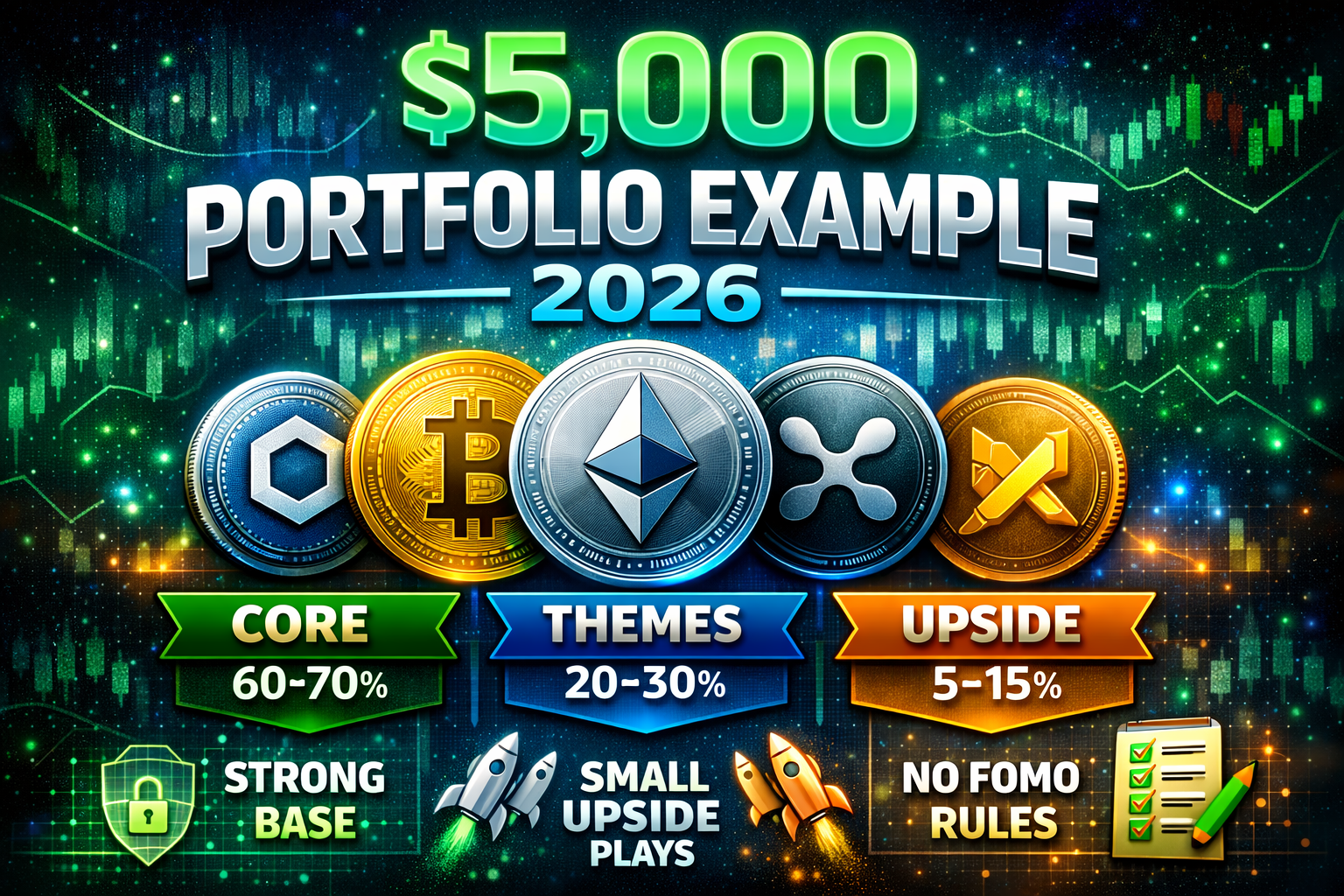
$5,000 Crypto Portfolio — July 2026 Example
This July 2026 playbook uses an exact six-asset allocation: BTC and ETH as the 55% foundation, then XRP, LINK, ONDO and SOL as distinct infrastructure theses. No mystery “pick one” sleeve and no yield rate used to justify token selection.
Goal of this playbook
Build a mid-size crypto-only example that is easier to understand and review through volatility.
With $5,000, the structure keeps 55% in BTC + ETH and allocates the remaining capital across four measurable 2026 theses.
Portfolio structure (simple)
- Core (55%): BTC and ETH as the portfolio foundation.
- Infrastructure themes (35%): XRP, LINK and SOL across settlement, interoperability and execution.
- Tokenized markets (10%): ONDO as a higher-risk RWA and value-capture thesis.
Suggested allocation (example)
This July 2026 example assigns an exact dollar amount to all six assets. The weights are illustrative research allocations, not personalized recommendations.
Why I changed the July 2026 allocation
The previous version used a 15% “pick SOL / AVAX / NEAR” sleeve. That made the reader choose between three unrelated theses and could turn one allocation into two or three smaller positions. This version uses SOL at a fixed 10% and raises BTC to 35%.
Five-tranche deployment example
Divide the $5,000 example into five $1,000 deployment rounds. Each round uses the same target weights.
Buying plan (how to deploy without chasing)
- Five staged entries: split the portfolio into five $1,000 deployment rounds using the same target weights.
- No automatic chasing: vertical price expansion is a reason to re-check entry risk, not proof you must buy immediately.
- Deploy by rule: use planned tranche dates or meaningful pullbacks only when the underlying thesis remains intact.
Risk rules (what keeps you alive)
- No leverage. No revenge trading.
- Thesis risk stays capped: ONDO and other higher-risk positions do not become core holdings simply because they outperform.
- Review quarterly: rebalance when weights or theses materially change, not because one token had a loud week on X.
- Define thesis failure: weakening liquidity, adverse supply changes, broken catalysts, or ecosystem growth without token value capture should trigger review.
Quarterly thesis review
- BTC: spot ETF flows, liquidity, network security, macro sensitivity, and miner economics.
- ETH: settlement activity, stablecoins, tokenization, fees, staking demand, and ETH value capture.
- XRP: institutional-product flows, XRPL usage, payment activity, liquidity demand, and direct XRP value capture.
- LINK: CCIP usage, CRE adoption, institutional data integrations, fees, staking economics, and LINK demand.
- ONDO: tokenized-stock and Treasury growth, governance utility, supply, unlock pressure, and ONDO value capture.
- SOL: stablecoin activity, payments, tokenized assets, fees, resilience, and SOL economic demand.
Custody, staking and third-party yield are separate decisions
Buying an asset, choosing custody, staking through a protocol, and transferring crypto to a third-party interest platform are different decisions. A high advertised rate should never be the reason a token enters this portfolio.
- Self-custody: key-management and wallet-security responsibility.
- Native staking: protocol, validator, slashing, smart-contract, and lockup risks can apply.
- Custodial interest: counterparty, custody, liquidity, legal, and asset-use risks.
For a separate review of advertised rates, custody terms, and platform risks, see the CoinDepo research review →
CoinDepo rates, terms, and availability can change. Some links in the separate CoinDepo report are referral links and are clearly disclosed there. Third-party interest is not protocol yield and is not used to justify this portfolio example.
About · Contact · Editorial Policy · Terms · Privacy
Next playbooks
- Memecoin Sleeve Playbook (strict sizing + rotation rules)